About


Hello.

This is my blog-format project for reviewing albums. My aim is to have every single album I own reviewed - but as my current collection includes more than 400 albums, It'll take me several years even if I manage to review an album every other day - thus this might end up as a forever-project. Anyway, I guess listening the stuff I own and writing about it is better pastime than just pointless surfing over the web.

With my reviewing method I will look at the album both one song at a time and as a whole, the final score being a rounded average score of the songs.

Unless I get better ideas, I will review the albums in a completely randomized order, using a random number generator.

And this link here is for those who are interested in what I actually listen to.

Currently reviewed: 11 out of 520 albums.

Showing posts with label post-rock. Show all posts

Friday, August 5, 2011

Godspeed You! Black Emperor

(1994-2003, 2010-)
Past and present members:
Thierry Amar – double bass, bass
David Bryant – guitar, tapes
Bruce Cawdron – drums, percussion
James Chau – keyboards, harpsichord, guitar
Fluffy Erskine – film projections
Aidan Girt – drums, percussion
Norsola Johnson – cello
Karl Lemieux - film projections
John Littlefair – film projections
Efrim Menuck – guitar, tape loops keyboards
Mike Moya – guitar
Mauro Pezzente – bass
Thea Pratt – French horn
Sophie Trudeau – violin
Roger Tellier-Craig – guitar
Grayson Walker – accordion

The Canadian Godspeed You! Black Emperor (commonly abbreviated to GY!BE) is often regarded as the godfather of post-rock, a musical genre encompassing numerous different styles that are centered on instrumental, or mainly instrumental music that is mostly played with traditional rock instruments (eg. drums, bass and guitar).

GY!BE is not the progenitor of this genre, as there are several bands older than them that have played instrumental music that can be regarded as post-rock, but GY!BE is definitely one of the most important influencers on this whole genre of music. Their music is not simple, riff-based instrumental rock music, but instead draws heavily influences from classical music and minimalism, and the songs are often composed of various movements, in which the motif is varied throughout. GY!BE was also one of the first bands to expand their instrumentation from a simple rock outfit to a one sharing common elements with classical music orchestras - throughout their existence they have had various bowed instruments, brass and percussions in addition to their electric string instruments and drums. This adds to their classical sound very much, and together with their massive, often well over 20-minute compositions, they are as much a contemporary classical orchestra as a rock band.

Also, due to their song lengths, GY!BE is not music for people with short attention span - modern post-rock songs are often quite short, somehow riff based compositions, whereas in GY!BE songs the band can easily spend several minutes playing just two chords, adding things and taking stuff away, developing the harmonic texture and mood of the song, making it probably a bit dull to the people who enjoy mostly short and easy post-rock songs, and very boring especially to the people used to standard radio hit singles with a sing-along chorus and catchy riff.

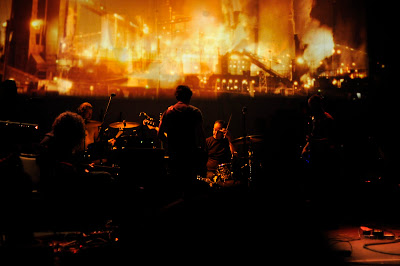
GY!BE has always been a very impressive band live. In addition to the samples and album liner notes, their political, left-wing stance is often represented through the film loop projections in their concerts, and their film projectionist is also regarded as a full member of their already extensive lineup. The band performs in a semi-circle, facing each other instead of audience, and they usually make very little contact with the attendees, becoming completely absorbed in the music.

Their guitarist, Efrim Menuck, is often regarded as the "leader" of the band, but this role is not actually that of a real band leader, but one that comes from him being one of the original founding members the person usually communicating with the media. He, however, has many times expressed his views as a rock idol, and usually, when performing with Silver Mt. Zion, he communicates with the audience with really down-to-earth fashion, discussing current topics, as if just being one of the crowd.

GY!BE ceased all activities in the early 2000's, and many believed they had really quit, although they had stated that it was only an indefinite hiatus. Then, suddenly, in 2010 they announced they would be performing once again, and even I managed to see them live in early 2011. Currently they are believed to be writing new material.

***

My list of songs that are worth checking out:

Well, they haven't really done anything not worth checking out.


***

Reviewed albums:
Yanqui U.X.O. (2002) - 96/100

Thursday, August 4, 2011

Godspeed You! Black Emperor // Yanqui U.X.O.

Album: Godspeed You! Black Emperor - Yanqui U.X.O. (2002)
5 tracks / 75:00
Acquired: July 2007

Guitars: David Bryant, Efrim Menuck, Roger Tellier-Craig
Bass: Thierry Amar, Mauro Pezzente
Drums: Bruce Cawdron, Aidan Girt
Cello: Norsola Johnson
Violin: Sophie Trudeau


I discovered the Canadian instrumental band Godspeed You! Black Emperor (henceforth abbreviated as GY!BE) some five years ago, back in '06, but it took me almost a year to come across one of their records (well, I wasn't really looking for them, just hoping if you could stumble across one). It was this one - the last album they have recorded to this date.

Yanqui U.X.O. is somewhat unlike the previous works of the band. The album has less ambient sounds than the previous ones, and the songs are long, instrumental rock epics that go under a single title, whereas their earlier works have relied much on field recordings and the songs have been composed of several, specifically titled movements that together make a massive song - not unlike classical music.

I haven't really decided on my favorite GY!BE album, because every single one of them is pure bliss to my ears, but if I really have to put my money on one, I'd pick this one. Though their debut album, F♯ A♯ ∞, contains "East Hastings" - my favorite post-rock song of all time - I guess this album is the one I enjoy most from the first moments to the last fading notes.

1. 09-15-00 (Part One) (16:27)

Opening with complete silence, this song starts to grow and evolve into a surreal, sprawling soundscape of dreams. After several minutes of this movement, the mood shifts and the song's pulse becomes more pronounced with subtle differences in drumming and bass lines. In time, they cease, giving way to a melancholic string instrument melody, that marks the end of the first half.

The second half begins with a quiet interlude in to which a cello, a violin and finally a guitar join in, one after another. The quiet and calm atmosphere starts to crumble as the intensity grows along with distortion, dissonance and increasing tempo. After ten minutes, this song that was reminiscent of modern classical music interspersed with electric guitars, has evolved - slowly, steadily, and without warning - into a massive, galloping instrumental rock epic - until coming to an almost complete halt.

During the course of final minutes the song manages to grow once again into massive, majestic proportions, that grow and grow, until the song reaches its discordant climax and wailing, crumbles back into silence.

A massive masterpiece, showing the true colors from the band. The amazingness of this song - and this band - doesn't come from clever riffs or insightful lyrics; it comes from the interplay of those instrumental textures, that weave themselves into each other, creating whole world within the frame of one single song. Almost every movement is impressive, touching or simply pleasing, yet it would be impossible to put them in an order. This band can express more feelings and impressions within one song that a normal band could during one album - or even a career.
10/10

2. 09-15-00 (Part Two) (6:17)

Length-wise, this is a real GY!BE hit single - it is their shortest song after the 5-minute "Sunshine + Gasoline" on Amazenine 7"-split - and the only track clocking under 10 minutes on any of their official full-length records.

"Part Two" is a lot calmer than "Part One", mostly consisting of reverbing bass chords, chiming guitar notes and ambient noise over a quiet cymbal beat. It isn't such an emotional rollercoaster as the first part was, but instead a quiet and dreamy transition track or outro.
9/10

3. Rockets Fall on Rocket Falls (20:42)

Beginning with muted and delayed guitar figure, this song slowly begins to sprawl and unravel all around. Instrument after another join in, creating melodies, rhythms, harmonies and textures that overlap, intertwine and support each other.

Then suddenly you realize that the song has grown into majestic proportions, being a massive, rumbling giant, smashing everything around it with such a power and force you can't fathom where it really comes from. And it continues, and it continues, and it continues, and it fades.

The song progresses on with a very Stravinsky-esque loan into a movement, that could easily be a GY!BE-rendition of The Rite of Spring. The band remain in this funereal procession movement for some time, bringing up slowly a texture after another over it, playing with the atmosphere and intensity, until the mood begins to progress further.

Yet the oppressive march movement dominates the majority of the song, making it feel like as if you are falling down, without ever hitting a surface, almost like a slow-motion soundtrack to a dream in which you keep falling. However, the song finally ends with massive, crashing coda section that finally dies away, leaving a bass and the string instruments playing, like a small house band playing over a scene of great destruction.

"Rockets Fall on Rocket Falls" is maybe a slightly too repetitive or long, to make it to my favorite tracks, but still it remains incredibly impressive when regarded as a whole.
9/10

4. motherfucker=redeemer (Part One) (21:22)

And thus begins the biggest mammoth of the album - the majestic first part of "motherfucker=redeemer".

Beginning with quiet chimes becoming more and more frequent, the song itself rolls in very slowly. After several minutes, a distant riff of several guitars playing each other starts to emerge, repeating this circling pattern over and over again, being suddenly joined by surprisingly fast-paced drums and strings.

The motif of this movement is varied over and over with a constant and fast pulse of drumming, becoming more and more complex, growing and sprawling, becoming in the end a massive, orchestral wall of sound, led by a sorrowful violin melody, until it feels as if it can't withstand its own weight and starts to collapse, crashing.

The song calms down and slowly progresses on to the next section, still maintaining that steady drum beat for a while, until it dies too, leaving nothing but echoing guitars that play broken chords over each other.

For a small eternity, the band moves nothing from there, just painting aural sonicscapes with guitars, until a high-pitched, desperate lead melody emerges and leads the song to its closure.

A breathtaking masterpiece, that first wears the listener down with the vigorous first part, and then gives a long moment to catch breath with the ethereal last part.
10/10

5. motherfucker=redeemer (Part Two) (10:10)

The album closes with the second part of "motherfucker=redeemer" that is only half in length compared to its bigger sibling - a short and radio-friendly 10-minute hit single (by GY!BE standards).

The long, calm section during the previous song was well placed and well needed, for the song quickly evolves into an exhilirating pulse of bass and crashing drums, backed by heavily effected guitar buzz.

The song gains more speed and force as it progresses through the main section, becoming the fiercest and rawest song of the whole album, as if releasing all the anger and pressure that had been building along the album.

As the song, and the album, are reaching the end, the song grows even more before exploding into an ocean of noise that begins to die out, slowly, until being suddenly gobbled up by an abrupt ending.

The final track of Yanqui U.X.O. is definitely more straightforward and "rock" compared to the rest of the album, but also succeeds in bringing the album alive after songs that have been very dreamy and minimalistic, before a stylish close.
10/10

***

Final verdict
This album - or any work of this band, for that matter - is not music for a person that has an attention span of an average chicken. With one exception, the songs exceed 10 minutes - three out of four easily - and they can circle round a single motif for more than an average pop song's length. Most parts are very minimal, having a very simple structure, and the appeal of the songs comes how the band can play with those simple parts, putting ideas in, taking them out, evolving them on and on, until you realize you are listening to something completely different from moments ago.

Yanqui U.X.O. is generally not as highly praised album as their earlier works, due to its obvious lack of samples, but the way I see it, the band have let the songs speak for themselves, not letting other people's voices come in the way.

It is also angrier, more raw and more straightforward than their earlier works - still, with over 20-minute epics, they are pretty far from MTV material. Though for a listener not used to post-rock or classical music, listening to this album might be as boring as watching paint dry, but with any appreciation to skillfully crafted music, that grows and evolves almost like a living being, this album is a must.

Score: 96/100

Tuesday, July 26, 2011

Mono

(1999-)

My definitive lineup:
Yoda - Guitars
Kunishi Tamaki - Bass, piano
Takada Yasunori - Drums
Goto Takaakira - Guitars

Japanese Mono have been one of the forerunners of bands who create music that is as much rock music as it is classical yet not being either one of them. Though not as influential as the great godfather of post-rock, Godspeed You! Black Emperor, Mono is still one of the most recognized names in the world of post-rock.

During their first albums the band named some shoegaze bands as their greatest influences, which can be heard especially from their earlier music - it lends much from earlier post-rock bands, yet it nods to the direction of instrumental shoegaze as well. However, during their last few albums they have drawn heavy influence from classical music, which is underlined with the use of a chamber orchestra in their 2009 album, Hymn to the Immortal Wind. Despite this, their songs have always been very reminiscent of classical music - with the exception that it is played with traditional rock instruments. The songs are usually very long, having very minimalist composition, being based more on repetition and introduction of new layers of instrumentation instead of changing riffs and catchy melodies. Also many times leitmotif-type ideas are introduced and varied throughout the song, in vein of classical music. The main difference between their early and later works is that their earlier works are mostly bright, pretty and somehow nostalgic, whereas the couple more recent albums are dripping with intense melancholy and sorrow, borderlining between pathetic movie music and breathtakingly beautiful contemporary classical music.

I've heard some people grouping Mono together with the so-called "quiet/loud/quiet"-post-rock bands, which superficially may be true, but most of these bands base their music on simply parts that are loud and heavy and parts that are quiet and calm, which then are contrasted one after another. How Mono then differs from these bands, is the use of full dynamic spectrum in their music - the loud and heavy parts don't come right after the quiet ones, or the other way around, but instead slowly grow and evolve from them, making it occasionally impossible to point out when the quiet movement turned into a loud one.

To this day Mono's line-up has remained unchanged, and the band is led by their main composer and guitarist Goto Takaakira. One of the main distinctive feature of Mono's sound is Goto's, and their rhythm guitarist Yoda's, extensive use of delay and reverb, creating a dreamy and wavy feel to the songs. Also Mono seems to have polished the incredibly massive wall-of-sound guitar assault to the brightest already during their first works. Fuzz-and-delay-heavy guitar sound that is tremolo-picked creates this massive guitar noise that sounds more like a distorted, bowed instrument than a regular guitar lead, creating a massive sound that is perfect to underline an important crescendo part during a lengthy song. It was used already during their debut album and to this date it remains probably the single most important feature of the so-called recognizable Mono-sound - even though it also has become one of the most mimicked features of the modern quiet/loud/quiet bands.

Also after having seen one of their live shows, I must point out that these guys really put on an impressive show. It seems to be impossible that a band of which only one person (bassist Kunishi Tamaki) is standing up - rest of them playing seated - could play with such intensity, but it is really possible. During the quiet parts the players are almost still, only moving a little to the rhythm, but once the songs reach their climax, the players heave and sway frantically, as if in trance in which they don't move to the music, but the music moves them. Combined with the incredible sound and soundscapes they create, Mono is truly an instrumental band that needs to be seen.


***

My top-10 list of songs that are worth checking out:
2 Candles, 1 Wish
Burial at Sea
COM(?)
Error #9
Halcyon (Beautiful Days)
Halo
The Battle to Heaven
The Flames Beyond the Cold Mountain
The Kidnapper Bell
Yearning


***

Reviewed albums:
Under the Pipal Tree (2001) - 90/100

Mono // Under the Pipal Tree

Album: Mono - Under the Pipal Tree (2001)
8 tracks / 63:44
Acquired: September 2010

Guitars: Goto Takaakira
Guitars: Yoda
Bass: Kunishi Tamaki
Drums: Takada Yasunori


Mono was one of the first post-rock bands I've listened to back in 2005 or 2006 and Under the Pipal Tree was the first Mono album I found. However, after I found more of their more recent stuff, I somehow started ignoring this album unconsciously and that's why it took me some five years before I managed to buy a physical copy.

In a nutshell, this is an album full of lengthy, completely instrumental songs, and even though an occasional cello in two of the songs can be heard, all of them are performed with traditional rock outfit - bass, drums and two guitars - yet more connections to classical music can be made than to rock music.

Now we shall delve into the debut album of one of the greatest names in the post-rock front.

1. Karelia (Opus 2) (12:30)

The album opens with calm introduction played with clean, delay-heavy guitars that fade in very slowly. However, very quickly this song opens up into a Mono regular: distinct guitar textures, frenetic drumming and finally a massive, fuzz-heavy wall-of-sound guitar.

The song goes through its massive ups and fragile, cello-tinted downs with ease, carefully using the whole dynamic range. Even when my speakers are almost up to eleven, the interlude in the middle is pretty damn quiet, until interrupted by wailing guitar bends that kick the song into full speed once again.

"Karelia (Opus 2)" is both one of the few somehow Finland-related tracks, and an excellent Mono song. It is a perfect example what post-rock is all about: making the song a real rollercoaster using both slow and quiet parts, contrasted with massive and crushing parts. The song is well over 10 minutes long, yet it always feels to be of excellent length - too short, if anything.

For some time, this remained as one of my most favorite Mono songs. It still is pretty amazing, but I really can't give it full points as I know there are even better ones out there.
9/10

2. The Kidnapper Bell (10:00)

As "Karelia" fades out, The Kidnapper Bell starts to fade in - and as slowly as the starter. With Mono in lead, there's no need to rush. The songs take several minutes to open and once they do, they feel like they could contain a lifetime of music yet never making me feel bored. The Kidnapper Bell is a song song in this vein - melodies of intricate beauty, held steady with melodic bass lines and rock-steady drumming. The further the song goes, the more it feels that the song takes up the whole aural atmosphere and fills everything with interweaving, harmonious textures.

Especially the latter half is really massive, almost crushing with its immense heaviness (not in heavy-metal way) created by pulsating bass guitar chords and Goto's trademark guitar wall-of-sound.

"The Kidnapper Bell" really has no distinct, sing-along melodies, yet it is one of their most amazing works to this date being made of musical beauty of almost unreal quality. It is incredible to see how Goto has been one of the most stunning post-rock composers all the way from their first full-length album.
10/10

3. Jackie Says (7:31)

Though not kicking in at full speed, "Jackie Says" still shows it true colors a bit faster than the two previous ones did - and is also a bit lighter than those two darker songs. "Jackie Says" sways on with slow, massive pace in which heavy bass chords are contrasted with light and twangy guitar melodies and harmonies.

However, as post-rock is more about soundscapes than compositions, this song seems a bit "hollow" due to its lack of midranges. The guitars twinkle and wail at high registers, while the bass pounds the low ones, but this song seems to be lacking the massiveness up until the final quarter, making this song feel a bit unbalanced. But maybe I've just grown too accustomed to the regular Mono sound and when they want to do something otherwise, it just doesn't hit the spot for me.

Anyways, a nice song, but I must say it lacks that special something that many Mono songs have.
7/10

4. OP Beach (5:48)
The guitar-drums-duet opening "OP Beach" evolve quickly into a slow, fragile swayer of strong melancholic feel. A sorrowful and somehow nostalgic piece yet not lacking in hope. A great song showcasing that Mono don't need to use wah-fuzz-delay combo in every song - they can make tremendous songs only with a couple of clean guitars backed by bass and drums.
9/10

5. Holy (1:40)
"Holy" is more of an interlude than a song, consisting of a melancholic guitar melody played with reverse delay, suddenly creating an unreal, even a bit eerie atmosphere right after the soothing "OP Beach". However, a nice intermission that remains enjoyable because of its moderate duration.
9/10

6. Error #9 (12:30)
Another really lengthy piece that begins with quiet, atmospheric effects that mask the sound of guitar completely until another distinct guitar melody with the bass appear.

"Error #9" is another very Mono-esque track with pulsating rhythm created with the steady teamwork by Kunishi and Takada, on which the guitars weave aural bliss with delay-heavy guitars. These guys really seem to have the uncanny ability to know when to remain quiet and when to crush everything in sight with unrelenting sonic onslaught. Especially the quieter parts which are very bass-driven moments are really enjoyable, even though the whole song is as great as any Mono track.

The whole first, quiet half of the song serves as a contrast to the suddenly exploding loud part that encompasses the latter half almost completely, making this song into a combination of two distinct and unlike phases that still work together seamlessly. Together they make an amazing song, whereas both separately would be pretty great but a lot more one-sided, unbalanced.
10/10

7. L'America (4:37)

Another soothing slow-tempo track. Remaining bright and peaceful throughout, it works as a great counterpart to the preceding heavy part of "Error #9". It really doesn't go anywhere, just lulls around in a peaceful sway, though having a short climatic moment somewhere in its last third.

As a relatively short song - taking the average song length in this album into consideration - this song serves purpose both as a separate song and as an interlude between two lengthier tracks. All in all, a short but very enjoyable piece.
9/10

8. Human Highway (9:05)

The album closes with another lengthy epic, "Human Highway". It doesn't add anything new to the Mono palette, it simply does what the band is good at.

A small deviation from the general sound is the inclusion of a cello; bringing more depth and warmth to the already-winsome sound of the band.

"Human Highway" is a gentle giant, having layers upon layers of melodic guitar textures and rumbling bass chords intertwined with soft cello melodies. Once again, dynamic scale is used to the full extent to underline the emotional climaxes and to bring peace to the calmer moments. A perfect way to end the album; "Human Highway" never reaches a full-scale wall-of-sound crusher, but takes a turn to the quieter direction in place of it, and starts to slowly die out, until only a handful of silent notes linger on.
9/10

***

Final Verdict
Under the Pipal Tree is incredibly mature for a debut album, full of instrumental bliss from the beginning to the end. Instead of emphasizing rock instrumentation performed in post-rock aesthetics, Mono use their instruments and composition to create a blend of rock and classical music. With Godspeed You! Black Emperor's work, this album is a benchmark for post-rock bands that don't just play instrumental rock music, but also put on a great deal of emphasis on the dynamics and the dramatic play of the songs.

But also being a noteworthy album, it is also a very enjoyable and impressive one. Though the songs together aren't as coherent as the ones in the later albums, they are amazing post-rock songs on their own, and though Mono has done some really impressive works later on, their debut album is not overshadowed by them, and still remains as outstanding as ever. Under the Pipal Tree is really a "must" album for any post-rock listener.

Score: 90/100